The Hours Nobody Is Watching: After-Hours Security for Tobago’s Businesses
A business is open for nine hours and closed for fifteen. Three gaps we find most often in after-hours cover, and what a proper arrangement specifies instead.
In brief
- A business is open for nine hours and closed for fifteen
- Gap one: nobody owns the last hour
- Gap two: an alarm is a message, not a response
- Gap three: a patrol on a timetable can be read
- Six things a proper after-hours arrangement should specify
Ask a business owner in Tobago to describe their security, and they will usually describe the day: the officer at the door, the camera behind the counter, who has keys. It is a fair answer, and it covers the nine hours the place is full of people and the takings are being watched by everybody in the room. The trouble is that the other fifteen hours are where the risk actually lives, and they are the hours the arrangement was never really designed around.
This is not a failure of care. It is a failure of specification. Almost every after-hours weakness we find on site comes down to something nobody wrote down, because everybody assumed somebody else had. Three of them come up often enough to be worth naming.
Gap one: nobody owns the last hour
Staff lock up and leave at six. The cover starts at seven. Between the two, an hour belongs to nobody, and because it was never written in anything, nobody notices it is missing. The same gap usually exists at the other end of the night, between the last check and the first member of staff arriving, and it’s also the moment somebody stands alone at a door with the keys and the alarm code.
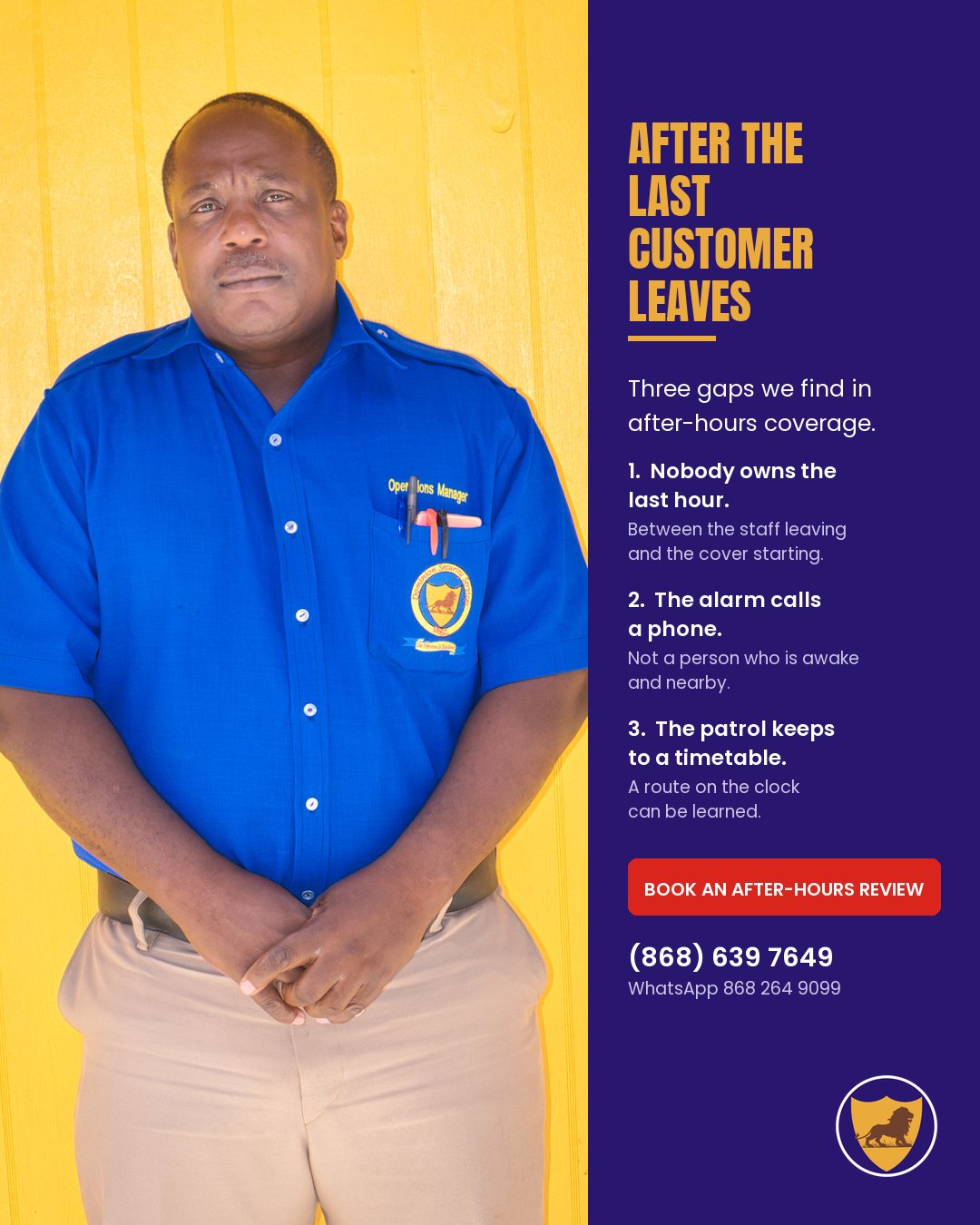
The fix costs almost nothing. Decide who is responsible for the premises at every hour of the twenty-four, write it as hours rather than as people, and check that the handover at each end is a handover rather than a hope. A gap you have named is a gap you can close. A gap you have assumed away is the one you discover later.
Gap two: an alarm is a message, not a response
An alarm system is often bought as though it were security. It is not. It is a notification, and its entire value depends on what happens in the minutes after it sounds. So the questions worth asking are not about the panel. Who is called, in what order, and is that a monitoring centre or a mobile number? Is that person awake at two in the morning, and is it their job to be? Who physically attends, from where, and how long does that road take at night?
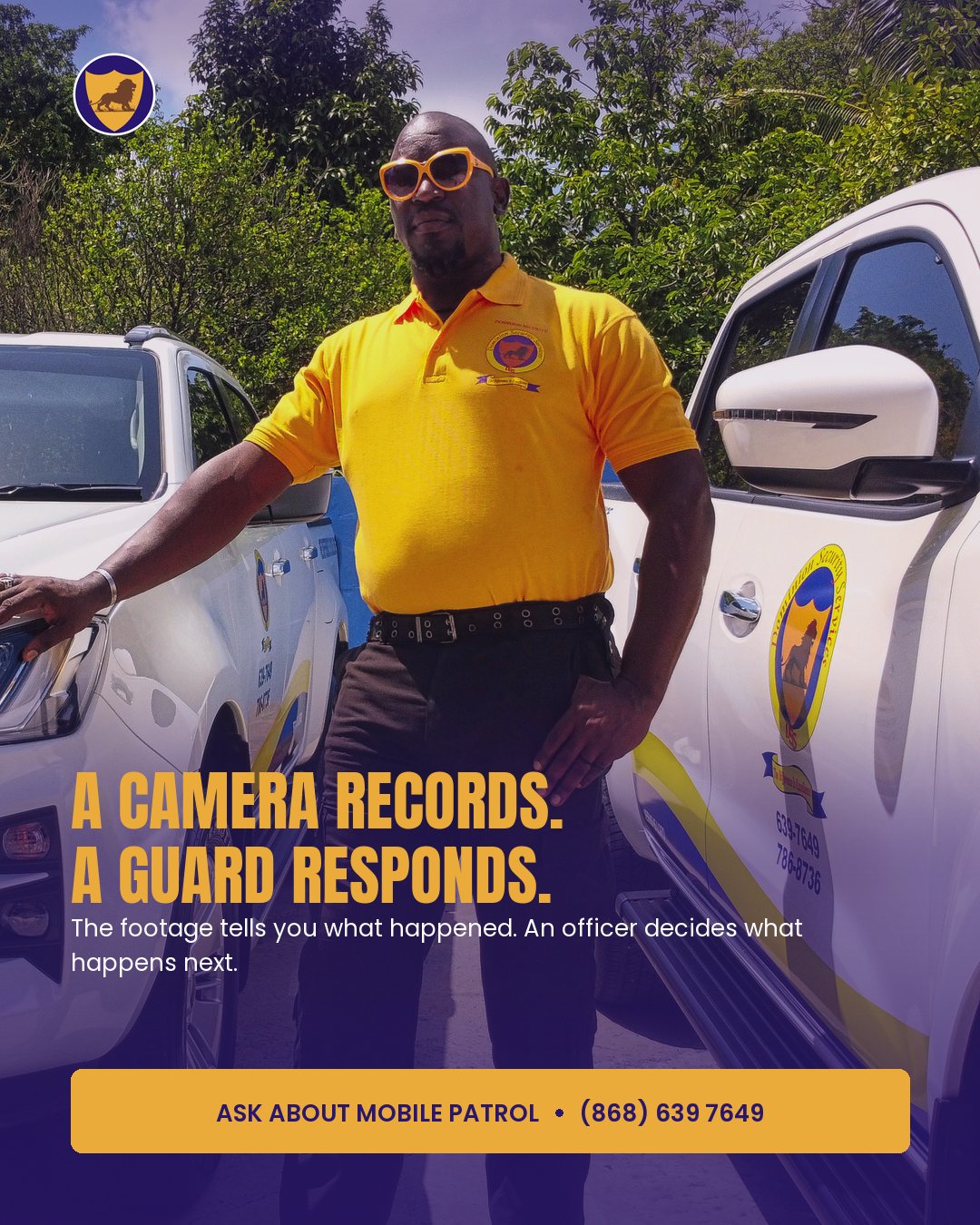
On an island the size of Tobago, those are not technicalities; they are the whole question. A response time is a real number that can be measured, agreed and written into a service. If a provider cannot give you one, you do not have a response. You have an alarm.
Gap three: a patrol on a timetable can be read
A mobile patrol that checks a premises at ten, midnight and two is doing something genuinely useful, and it is also doing it in a way that anybody paying attention for a fortnight can set a watch by. The value of a patrol is uncertainty: not knowing when the vehicle appears is what makes it work. A fixed schedule converts that uncertainty into information, and hands it over for free.
What to ask for instead is a randomised schedule within an agreed frequency, so you still get your three checks a night but not at three predictable times, together with a record you can actually see. A patrol that cannot show you where it was and when is a patrol you are taking on trust, and trust is not a reporting line.
What a proper after-hours arrangement specifies
Put plainly, an after-hours service should tell you six things before anybody signs anything: which hours are covered and by whom; what the handover is at each end of the day; how many checks a night and on what basis they are timed; what is recorded and how you see it; who is called when something happens, and who attends; and what the expected time to arrive actually is. None of those six is difficult to answer. A provider who answers all six in specifics is telling you how they work. A provider who answers in reassurance is telling you something as well.
Where each layer earns its place
A static officer buys presence and continuity, and is the right answer where a site has to be controlled rather than merely watched: a gate, a yard with movement in and out, a building where people are still coming and going after hours. A mobile patrol buys coverage across several sites at a fraction of the cost of manning each one, and suits premises that are genuinely empty overnight. A dog team buys perception on large or unlit ground, where senses beat sightlines. Cameras buy evidence and a wider field of view, and they buy nothing at all unless somebody has agreed to look at them.
The right question was never which of those to buy. It is what this particular site needs at two in the morning, which is a question that has to be answered on the site itself, in the dark, by somebody who has done it before. Most of what we find in an after-hours review isn’t dramatic. It is an hour nobody owned, a number that rang out, and a patrol that came at the same time every night. All three are cheap to fix, and all three are only obvious once somebody has stood there and looked.
Dominion Security Services has protected Tobago since 2003 and builds after-hours cover around the site rather than off-the-shelf.
Request a free security assessment
We will visit your site, look at the premises and advise honestly on the cover it needs, with no obligation. Prefer to talk? Call (868) 639-7649 or WhatsApp 868 264 9099.
Related: Mobile patrol and CCTV · Security officers · Armed officers and armed response